
Most people never think about their canine teeth, the pointy ones at the corners of your smile. But these teeth do a lot of work. They have the longest roots in the mouth, they help guide your bite when you move your jaw side to side, and they frame your smile. So when they don't come in the way they're supposed to, it's a big deal.
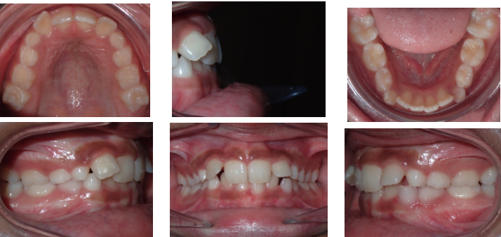
Today we're sharing one patient's journey from start to finish, using their actual X-rays, to show what happens when canines get "stuck" and how orthodontics can bring them home.
What Is an Impacted Canine?
A tooth is "impacted" when it can't come in on its own. Upper canines are one of the most common teeth to get stuck, second only to wisdom teeth. They form high up near the nose and have the longest path of any tooth to travel before they reach the mouth. If there isn't enough room, or if they start heading in the wrong direction, they can end up trapped in the bone.
When a canine is growing in the wrong direction, we call it ectopic, which simply means "out of its normal position." Left alone, an ectopic canine usually won't fix itself. It can also press against the roots of neighboring teeth and damage them over time.
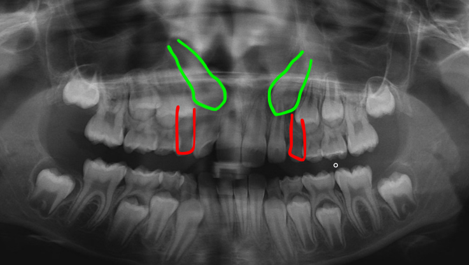
Problem. The X-ray above is one we took when our patient first came in. The teeth outlined in green are the permanent upper canines. Notice how high up they are, and how they're tilted inward toward the center of the face instead of pointing straight down. The teeth outlined in red are the baby canines, which were still hanging on because the adult teeth underneath weren't pushing them out.
Our patient also had crowding in both the upper and lower jaws. Simply put, there wasn't enough room for all the adult teeth to fit.
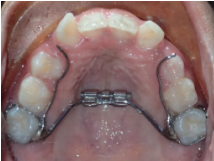
Solution Phase 1. Making Room With an Expander. Before we could bring the canines down, we needed to give them somewhere to go. We started with an upper expander, an appliance that gently widens the upper jaw over time (note the above photo). In young patients who are still growing, the upper jaw is made of two halves that haven't fully fused yet, so we can slowly widen it to create more space. This is one of the big reasons why we stress early evaluations.
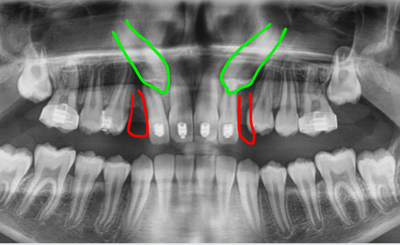
Solution Phase 2. Partial Braces. Next, we placed braces on some of the upper teeth. In the above X-ray you can see the brackets on the front teeth and bands on the back molars. This stage lines up the teeth we can reach, organizes the space, and builds a solid "anchor" we can later use to pull the canines into place.
Look at the canines (green) again. They're still sitting high, but compared to the first X-ray, they're more upright and have more room to come down. Notice the space forming between the teeth. The expansion and early alignment are doing their job.
Solution Phase 3. Uncovering the Canines (the "Exposure")
Because these canines were still buried, they needed a little help. This is where a minor procedure called an exposure comes in.
Let’s explain what happens, in plain terms: a surgeon (usually an oral surgeon or periodontist) gently uncovers the crown of the stuck tooth. A tiny bracket with a small gold chain is attached to the tooth. The area heals, and the chain is left tucked where we can reach it. From there, our orthodontic team connects the chain to the braces and slowly, gently pulls the tooth down into its proper spot over several months.
While that may seem scary, most patients are surprised by how manageable this is. The procedure is typically quick, and recovery is usually a few days of mild soreness, similar to having a tooth pulled.
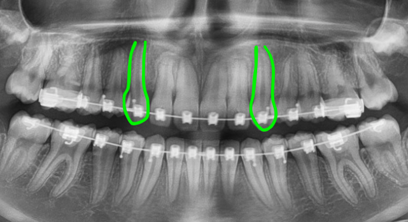
Solution Phase 4. Full Braces and the Finish Line. Once the canines were moving in the right direction, we added full braces on both the upper and lower teeth to fine-tune everything. This final X-ray above is the payoff: both canines (green) are now standing straight, fully in the arch, and lined up right alongside their neighbors.
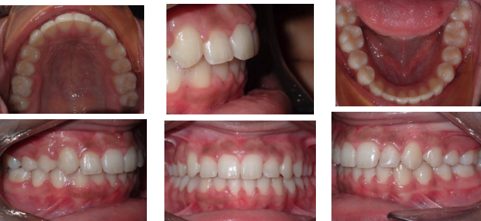
Results. The final photos above show that the crowding has been resolved, and the teeth are working together for a healthy, functional bite.From two teeth stuck high in the bone to a complete, beautiful smile. That's what teamwork, patience, and a good plan can do.
 Website Powered by Sesame 24-7™